
The Seller's Field Kit
Useful things for the weeks when the deal, the number, or both are giving you trouble.
Some weeks the deal goes quiet, the number looks worse than it did on Monday, and your manager wants an update you don't have yet. This is for those weeks.
It isn't a sales methodology. It's the handful of things I reached for when a quarter was going sideways, and a few I wish I'd reached for sooner. Find the problem you have this week and start there.
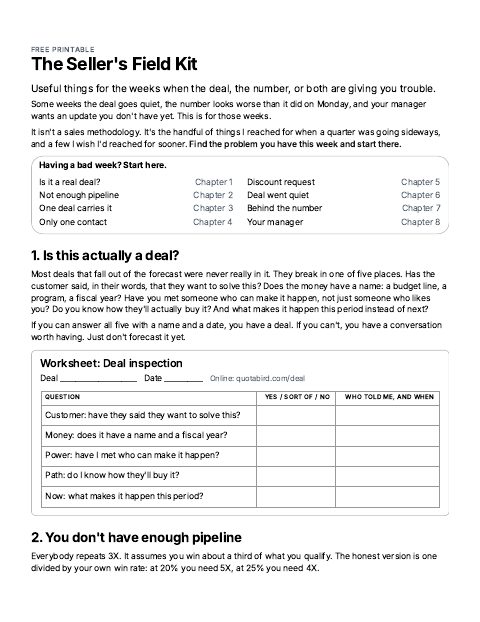
Having a bad week? Start here.
- Is it a real deal?Chapter 1
- Not enough pipelineChapter 2
- One deal carries itChapter 3
- Only one contactChapter 4
- Discount requestChapter 5
- Deal went quietChapter 6
- Behind the numberChapter 7
- Your managerChapter 8
1. Is this actually a deal?
Most deals that fall out of the forecast were never really in it. They break in one of five places. Has the customer said, in their words, that they want to solve this? Does the money have a name: a budget line, a program, a fiscal year? Have you met someone who can make it happen, not just someone who likes you? Do you know how they'll actually buy it? And what makes it happen this period instead of next?
If you can answer all five with a name and a date, you have a deal. If you can't, you have a conversation worth having. Just don't forecast it yet.
Worksheet: Deal inspection
| Question | Yes / Sort of / No | Who told me, and when |
|---|---|---|
| Customer: have they said they want to solve this? | ||
| Money: does it have a name and a fiscal year? | ||
| Power: have I met who can make it happen? | ||
| Path: do I know how they'll buy it? | ||
| Now: what makes it happen this period? |
2. You don't have enough pipeline
Everybody repeats 3X. It assumes you win about a third of what you qualify. The honest version is one divided by your own win rate: at 20% you need 5X, at 25% you need 4X.
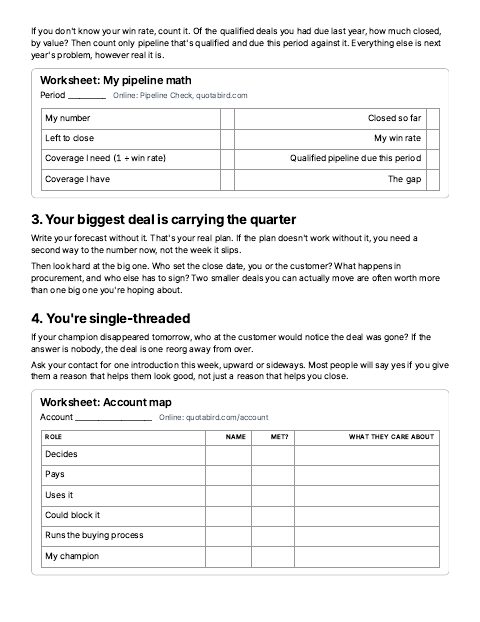
If you don't know your win rate, count it. Of the qualified deals you had due last year, how much closed, by value? Then count only pipeline that's qualified and due this period against it. Everything else is next year's problem, however real it is.
Worksheet: My pipeline math
| My number | Closed so far | ||
| Left to close | My win rate | ||
| Coverage I need (1 ÷ win rate) | Qualified pipeline due this period | ||
| Coverage I have | The gap |
3. Your biggest deal is carrying the quarter
Write your forecast without it. That's your real plan. If the plan doesn't work without it, you need a second way to the number now, not the week it slips.
Then look hard at the big one. Who set the close date, you or the customer? What happens in procurement, and who else has to sign? Two smaller deals you can actually move are often worth more than one big one you're hoping about.
4. You're single-threaded
If your champion disappeared tomorrow, who at the customer would notice the deal was gone? If the answer is nobody, the deal is one reorg away from over.
Ask your contact for one introduction this week, upward or sideways. Most people will say yes if you give them a reason that helps them look good, not just a reason that helps you close.
Worksheet: Account map
| Role | Name | Met? | What they care about |
|---|---|---|---|
| Decides | |||
| Pays | |||
| Uses it | |||
| Could block it | |||
| Runs the buying process | |||
| My champion |
5. The customer wants a discount
A discount is a trade, not a gift. What comes back? A signature date, more scope, a longer term, a reference you can use. And remember it comes out of your commission at the same rate it comes off the price.
Before you ask your manager to approve it, ask whether the problem is the price or the deal. A discount fixes price. It doesn't fix power, path or timing, and those are usually the real problem.
6. The deal has gone quiet
Busy and stalled look alike for about a week. Busy looks like short replies and moved meetings. Stalled looks like no replies and nobody else at the customer you can call.
Send one short note that's easy to answer: "Is this still a priority for this quarter, or should I check back in January?" A no is useful. Silence for two weeks after that's an answer too.
7. You're behind the number
Stop treating every deal the same. Sort them into three piles: can close this period on its own, can close this period with help, can't close this period. Put your time into the middle pile, and tell your manager exactly what help looks like.
Worksheet: Quarter rescue plan
| Deal | What has to happen | Who does it | By when |
|---|---|---|---|
8. Don't make your manager guess
Good managers don't need every detail. They need to know what changed, what might go wrong, and where you need help. "Still feeling good" isn't an update. "Procurement moved the date two weeks, Sarah told me Thursday, and I need you to call her VP" is an update.
Before the forecast call, try to break your own deals the way your manager will. Which of the five from chapter 1 would you defend? And ask for help before the deal is on fire: what you need them to do, and by when.
Worksheet: Manager update
What changed
Who told me, and when
What might go wrong
What I need from you, and by when
Sometimes another set of eyes helps
I'm Mark. I carried a number before I managed people who did, and later led partner sales teams at AWS. If you're staring at a deal, a forecast or a number that doesn't make sense, I'm happy to talk.
If one of these pages saves you one bad forecast call, it did its job.
Twenty minutes. Free. No deck. No pitch.
Or email me: mark@quotabird.com. And if I don't think I can help, I'll tell you.
Running a team? The Manager's Field Kit is the one for that.