Quota Case
Is your quota actually possible?
Use last year, your run rate, your pipeline and your win rate to find the gap. Build the case before you push back.
Use last year, your run rate, your pipeline and your win rate to find the gap. Build the case before you push back.
Start with what the quota is measured on, because the math changes. On a run-rate or whole-book number, the evidence is your current run rate, which already reflects today's team, plus the new pipeline you expect to win this year. On a bookings number, run rate doesn't tell you much, so it compares last year's bookings, adjusted for today's ramped headcount, with this year's pipeline at your real win rate, and takes the stronger of the two. Whatever's left between the evidence and the new number is the gap somebody needs to explain.
Take one-time deals out of last year. If a single giant deal made last year's number, building this year's quota on it is how a team ends up at 60% attainment and a lot of meetings about effort.
If you lost reps or have open territories, put in the headcount. On a bookings number it changes the capacity math. On a run-rate number, your run rate already reflects today's team, so headcount shows up as context and is never counted twice. A vacant territory still has quota. That's the problem. And a rep hired in March doesn't sell much until summer, so count reps when they're ramped, not when they start.
Don't walk in upset. Walk in with the gap and one question: what assumption am I missing?
Sometimes there's a real answer: new territory, a big renewal you didn't know about, a product launch, partner help with names attached. Then the number's hard but fair, and your job changes to helping the team hit it (here's how to hand it down), which means you stop relitigating it every Monday. Sometimes nobody has an answer. Then at least everybody knows where the number came from, and it's in writing before the year starts.
Your quota is crazy. Now prove it. has the longer version, including why the best time to have this fight is the year before.
Your quota assumes a lot about your territory. Here are five things it has to have. Take the answers to your manager in the first month, with the sizing behind them. In January it's planning. In Q4 it sounds like an excuse.
Spend you can actually sell into, by named account. If it isn't at least double the number, you're counting on share you have no real reason to expect. This week: Size the territory account by account. One page.
Not a list from the CRM. Ten accounts you personally expect to buy, with a reason for each. This week: Write the ten. If you can't get to ten, tell your manager now.
An installed base gives you something to build on. All new logos means starting from zero every year. This week: Split inherited from created, and put the inherited number on paper so nobody counts it twice.
You need one route per account, or it's just a name on a list. This week: Map one route per account: a relationship, a partner or a vehicle.
If nobody ever has, you're the experiment, and you should be paid like one. This week: Find the last person who had the territory and buy them coffee.
A bad answer won't get you out of the number, but it gets you a better conversation about it: a different territory, a different number, or a plan for how the gap gets filled. Selling federal? fedhoo shows what each agency in your territory spends and who's winning it.
Talk the territory through with Mark
This used to be Territory Check. Old links land here.
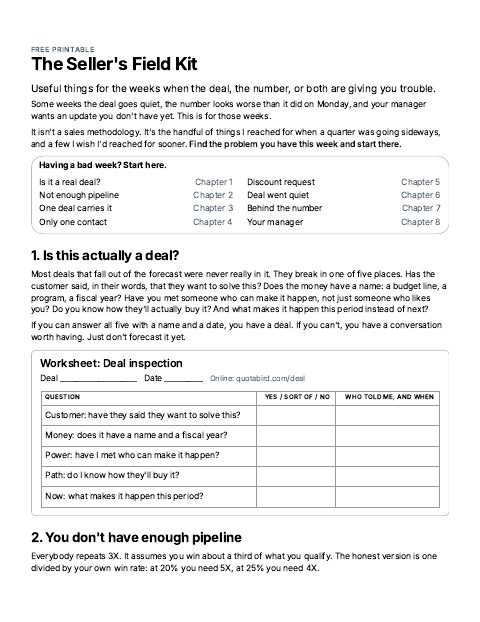
Useful things for the weeks when the deal, the number, or both are giving you trouble: pipeline math, a deal that went quiet, a discount request, and what to tell your manager.

I spent six years leading federal partner sales teams at Amazon, after plenty of years carrying a number myself. QuotaBird is mostly stuff I wish we'd had back then. Most of it's free. If the problem's messier than a little tool can handle, we can talk it through.