
The Sales Manager's Field Kit
Stuff I wish somebody had handed me the first time I ran a team.
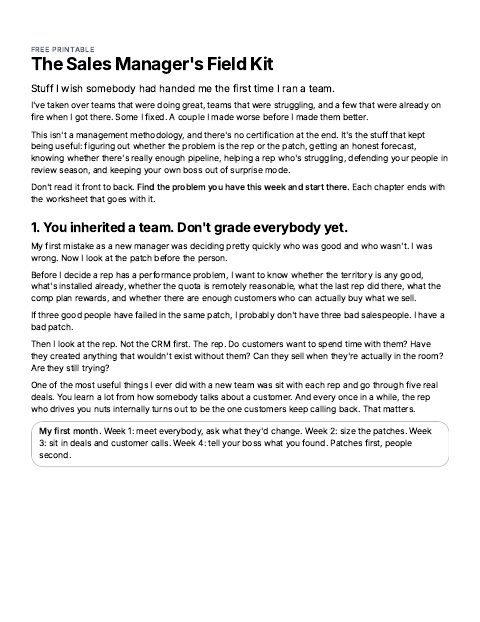
I've taken over teams that were doing great, teams that were struggling, and a few that were already on fire when I got there. Some I fixed. A couple I made worse before I made them better.
This isn't a management methodology, and there's no certification at the end. It's the stuff that kept being useful: figuring out whether the problem is the rep or the patch, getting an honest forecast, knowing whether there's really enough pipeline, helping a rep who's struggling, defending your people in review season, and keeping your own boss out of surprise mode.
Don't read it front to back. Find the problem you have this week and start there. Each chapter ends with the worksheet that goes with it.
1. You inherited a team. Don't grade everybody yet.
My first mistake as a new manager was deciding pretty quickly who was good and who wasn't. I was wrong. Now I look at the patch before the person.
Before I decide a rep has a performance problem, I want to know whether the territory is any good, what's installed already, whether the quota is remotely reasonable, what the last rep did there, what the comp plan rewards, and whether there are enough customers who can actually buy what we sell.
If three good people have failed in the same patch, I probably don't have three bad salespeople. I have a bad patch.
Then I look at the rep. Not the CRM first. The rep. Do customers want to spend time with them? Have they created anything that wouldn't exist without them? Can they sell when they're actually in the room? Are they still trying?
One of the most useful things I ever did with a new team was sit with each rep and go through five real deals. You learn a lot from how somebody talks about a customer. And every once in a while, the rep who drives you nuts internally turns out to be the one customers keep calling back. That matters.
My first month. Week 1: meet everybody, ask what they'd change. Week 2: size the patches. Week 3: sit in deals and customer calls. Week 4: tell your boss what you found. Patches first, people second.
Worksheet: Rep diagnostic
| In this order | Yes / Sort of / No | Notes |
|---|---|---|
| Patch: could a good rep make this number here? | ||
| Customers: do they want time with this rep? | ||
| Pipeline: is there pipeline only this rep created? | ||
| Craft: can they sell in the room? | ||
| Will: are they still trying to win? |
Patch is no: fix the situation. Craft is no: coach. Will is no: manage. Both no in a fair patch: see chapter 6.
2. Keep the 1:1 and the forecast call separate
These are not the same meeting. A 1:1 is about the person. A forecast call is about the number. Whenever I mixed them together, both got worse.
My 1:1 was usually thirty minutes, and the rep went first. What are they working on? What's getting in their way? What am I doing that's getting in their way? Then we look at one real deal properly.
I finish with one thing I saw them do well, one thing I'd try differently, and anything I said I'd do. Then I write my commitment down, and I do it. That last part built more trust than any management technique I ever learned.
Once a month I'd ask, "If you were running this team, what would you change?" You'll hear things nobody says in the staff meeting.
Worksheet: One-on-one
Their list: what's in their way, including me
One deal: customer, money, power, path, now
One thing they did well, one thing to try
What I said I'd do, and by when
3. The forecast call is not story time
To me, commit means the customer could explain how the money gets from them to us, and roughly when. Anything short of that is some flavor of hope. Most shaky deals eventually break in one of five places:
| Where it breaks | What I'm really asking |
|---|---|
| Customer | Do they actually want to solve this? |
| Money | Is there real money attached to it? |
| Power | Are we connected to somebody who can make it happen? |
| Path | Do we know how they actually buy? |
| Now | Why does anything happen this period? |
The best forecast question I know is still "Who told you that?" Not "what do you think," not "how confident are you." Who told you, and when? A named customer and a date beats enthusiasm every time. I've forecast plenty of enthusiasm. It has a terrible close rate.
When a rep and I disagree, I don't need to win the argument. I ask which of the five they'd defend to my boss, and we forecast that. Nobody has to lose face. The forecast just gets better.
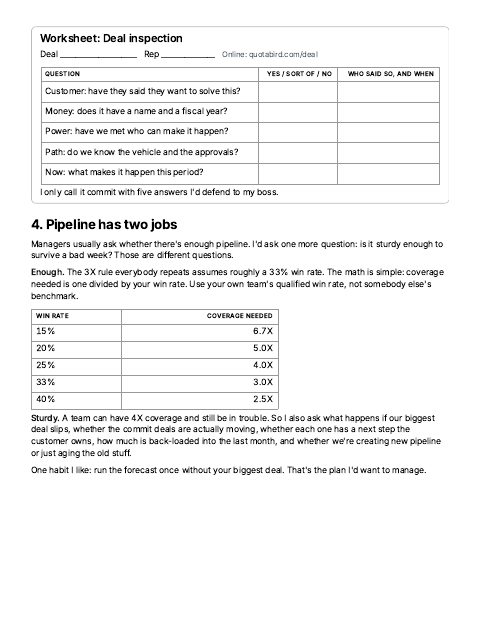
Worksheet: Deal inspection
| Question | Yes / Sort of / No | Who said so, and when |
|---|---|---|
| Customer: have they said they want to solve this? | ||
| Money: does it have a name and a fiscal year? | ||
| Power: have we met who can make it happen? | ||
| Path: do we know the vehicle and the approvals? | ||
| Now: what makes it happen this period? |
I only call it commit with five answers I'd defend to my boss.
4. Pipeline has two jobs
Managers usually ask whether there's enough pipeline. I'd ask one more question: is it sturdy enough to survive a bad week? Those are different questions.
Enough. The 3X rule everybody repeats assumes roughly a 33% win rate. The math is simple: coverage needed is one divided by your win rate. Use your own team's qualified win rate, not somebody else's benchmark.
| Win rate | Coverage needed |
|---|---|
| 15% | 6.7X |
| 20% | 5.0X |
| 25% | 4.0X |
| 33% | 3.0X |
| 40% | 2.5X |
Sturdy. A team can have 4X coverage and still be in trouble. So I also ask what happens if our biggest deal slips, whether the commit deals are actually moving, whether each one has a next step the customer owns, how much is back-loaded into the last month, and whether we're creating new pipeline or just aging the old stuff.
One habit I like: run the forecast once without your biggest deal. That's the plan I'd want to manage.
Worksheet: Team pipeline
| Rep | Number | Qualified pipeline | Win rate | Coverage needed (1 ÷ win rate) | Coverage now | Biggest deal |
|---|---|---|---|---|---|---|
If one deal is carrying a big chunk of the number, know exactly what happens if it moves.
5. Your boss mostly wants fewer surprises
I spent too much time early in management trying to give my boss more information. Usually they didn't need more information. They needed fewer surprises.
My update fits on one page: the number (commit, best case, gap), what changed and why, what worries me, what I'm doing about it, and one ask with a date. Or "nothing this week." And I lead with the bad news. "Heads up before this shows up in the CRM" beats letting your boss discover it.
I learned another one the expensive way. When somebody above me handed me a number I couldn't see, I used to say, "We'll find a way." Sometimes we did. Sometimes I spent the rest of the year explaining that sentence. Now I'd say, "Here's what I can commit to with what we have. Here's what would have to be true to get to your number." Then I show the math.
Worksheet: The five-minute boss update
| Commit | |
| Best case | |
| Gap |
What changed, and why
Biggest risk
What I'm doing about it
What I need from you, and by when
6. A struggling rep is a diagnosis before it's a verdict
Four very different problems can produce the same ugly dashboard.
| Problem | What it looks like | What I do |
|---|---|---|
| Bad situation | Good rep. Bad territory, quota, accounts or plan. | Fix the situation. |
| Skill | They're working, customers engage, deals just aren't converting. | Coach. Sit in the room. |
| Effort | They know how to sell. They're just not doing enough of it. | Set expectations clearly, in writing, with dates. |
| Wrong fit | Fair patch, enough support, and neither the skill nor the effort is there. | Now it's a performance conversation, not a coaching conversation. |
I want to rule out the first three before I convince myself it's the fourth. I once spent months coaching somebody whose territory couldn't have produced the number for almost anyone. I'd like those months back. So would the rep.
The rep diagnostic is in chapter 1. Online: quotabird.com/rep
7. Review season: bring receipts
The calibration room didn't see your rep's whole year. It saw whatever case you brought into the room. That took me too long to appreciate.
I keep a running note during the year: date, what happened, result. Nothing elaborate. Then review season isn't an archaeological dig through email and Slack.
For each rep I want three meaningful results (with numbers where numbers make sense), what happened because this person was there, why the work was at their level, specific examples behind any behavior I'm going to claim, and the harder thing I'd trust them with next.
Then I do one uncomfortable thing: I say the weakest part of my case first. It saves the room the trouble of finding it, and it makes everything else I say more credible.
I also check myself. Am I overweighting the last sixty days? Would I see this person differently if I didn't personally like working with them? Take away their biggest win: does my view hold? Take away their worst month: same question.
Worksheet: Talent review prep
Three results, with numbers where they make sense
What happened because this person was there
Why the work was at their level
Examples behind each behavior I'll claim
The harder thing I'd trust them with next
The weakest part of this case, said first
8. Things I learned the expensive way
- Managing the dashboard. The CRM got cleaner. The pipeline didn't get bigger.
- Saving the deal myself. Worked great once. Then the rep learned to wait for me.
- Managing the average. Two reps at 6X and two at 1X is not a healthy team at 3.5X.
- Forecasting confidence. Some people sound certain about everything. That's a personality trait, not deal evidence.
- Waiting to deliver bad news. I wanted the fix before I told my boss. They'd have preferred the news Monday and the fix Friday.
- Giving everyone the same 1:1. My best seller and my newest seller needed completely different things from those thirty minutes.
- Discounting the wrong problem. I approved a discount when the real issue was access to power. We solved a price problem the customer didn't have.
- Talking too much on customer calls. I thought I was helping the rep. Mostly I was teaching the customer to look at me instead of them.
- Being the answer machine. Eventually everybody brought me problems and nobody brought me decisions.
9. A few lines worth stealing
| When | What I say |
|---|---|
| A shaky deal | "Who told you that, and when?" |
| Moving something out of commit | "Which part would you defend to my boss?" |
| A rep is missing | "Forget the number for a minute. What's getting in your way?" |
| The target from above doesn't match reality | "Here's what I can commit to with what I have. Here's what has to change to get to that." |
| Bad news | "Heads up before this lands in the CRM." |
| A discount request | "What are we getting for it?" |
| A hard performance conversation | "Here's what good looks like thirty days from now." |
| You don't know | "I don't know. I'll find out by Thursday." Then find out by Thursday. |
10. When to leave the rep alone
Managers can hurt good sellers by managing them too much. I've done it.
I leave them alone when customers call them back, when they create their own pipeline, when they know their deals better than I do, when they tell me bad news before I find it, when they ask for help when they actually need it, and when they make the number often enough that the system clearly works.
My job isn't to turn my best rep into me. It's to make sure they have a fair patch, get the stuff that slows them down out of the way, help when they ask, and keep the rest of the company from improving them to death.
Sometimes another set of eyes helps
I'm Mark. I carried a number, managed people who did, and led partner sales teams at AWS. I still like this stuff. If you're staring at a deal, a forecast, a rep problem or a number that doesn't make sense, I'm happy to talk.
Twenty minutes. Free. No deck. No pitch.
And if I don't think I can help, I'll tell you.