
The Leadership Field Kit
For managers who want to become the person other leaders call when something matters.
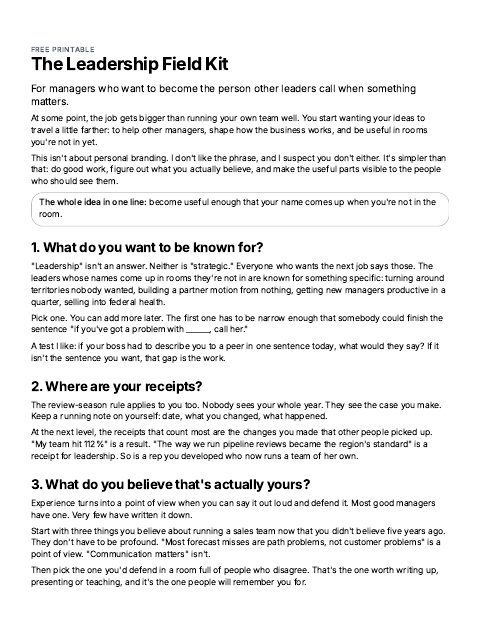
At some point, the job gets bigger than running your own team well. You start wanting your ideas to travel a little farther: to help other managers, shape how the business works, and be useful in rooms you're not in yet.
This isn't about personal branding. I don't like the phrase, and I suspect you don't either. It's simpler than that: do good work, figure out what you actually believe, and make the useful parts visible to the people who should see them.
The whole idea in one line: become useful enough that your name comes up when you're not in the room.
1. What do you want to be known for?
"Leadership" isn't an answer. Neither is "strategic." Everyone who wants the next job says those. The leaders whose names come up in rooms they're not in are known for something specific: turning around territories nobody wanted, building a partner motion from nothing, getting new managers productive in a quarter, selling into federal health.
Pick one. You can add more later. The first one has to be narrow enough that somebody could finish the sentence "if you've got a problem with ______, call her."
A test I like: if your boss had to describe you to a peer in one sentence today, what would they say? If it isn't the sentence you want, that gap is the work.
2. Where are your receipts?
The review-season rule applies to you too. Nobody sees your whole year. They see the case you make. Keep a running note on yourself: date, what you changed, what happened.
At the next level, the receipts that count most are the changes you made that other people picked up. "My team hit 112%" is a result. "The way we run pipeline reviews became the region's standard" is a receipt for leadership. So is a rep you developed who now runs a team of her own.
3. What do you believe that's actually yours?
Experience turns into a point of view when you can say it out loud and defend it. Most good managers have one. Very few have written it down.
Start with three things you believe about running a sales team now that you didn't believe five years ago. They don't have to be profound. "Most forecast misses are path problems, not customer problems" is a point of view. "Communication matters" isn't.
Then pick the one you'd defend in a room full of people who disagree. That's the one worth writing up, presenting or teaching, and it's the one people will remember you for.
Worksheet: My point of view
Three things I believe now that I didn't five years ago
The one I'd defend in a room that disagrees
The evidence I'd bring
Who disagrees, and where they're partly right
4. Build something other managers can borrow
The fastest way I know to become the person people call is to write down how you do something well and hand it out. Your operating rhythm on one page. How you run a forecast call. Your first thirty days with a new rep. A hiring scorecard.
It doesn't need to be polished. It needs to be useful enough that another manager uses it next week. When it spreads, your name travels with it.
Then offer to teach it. Thirty minutes at a leadership meeting, lunch with two newer managers, a session at the next kickoff. Teaching is also how you find out what you actually know.
5. Get into the right rooms
Recognition usually follows usefulness. Start with the people closest to the work: your boss, your boss's peers, and the leaders in the functions you depend on, like partners, marketing, finance and customer success. Then peers across the company. Then the industry.
The rooms worth being in are usually the ones where decisions about your world get made without you: the planning session where next year's territories get drawn, the review where your team's problems get explained by somebody else, the customer advisory board, the panel at your industry's conference.
The way in is almost always the same. Be useful to someone who's already in the room. Offer the template, the analysis, or the answer to the question they keep getting asked.
6. Bring people up behind you
The leaders who get recognized tend to be the ones whose people keep getting promoted. It's the most credible receipt there is, and the one you can't fake.
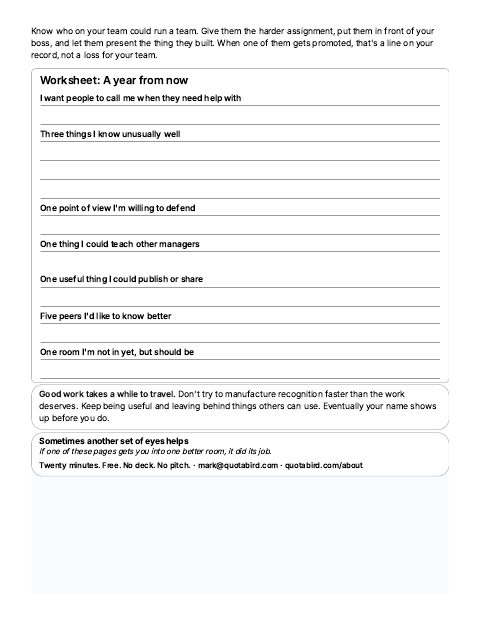
Know who on your team could run a team. Give them the harder assignment, put them in front of your boss, and let them present the thing they built. When one of them gets promoted, that's a line on your record, not a loss for your team.
Worksheet: A year from now
I want people to call me when they need help with
Three things I know unusually well
One point of view I'm willing to defend
One thing I could teach other managers
One useful thing I could publish or share
Five peers I'd like to know better
One room I'm not in yet, but should be
Good work takes a while to travel. Don't try to manufacture recognition faster than the work deserves. Keep being useful and leaving behind things others can use. Eventually your name shows up before you do.
Sometimes another set of eyes helps
I'm Mark. I carried a number, managed people who did, and led partner sales teams at AWS. If you want a second set of eyes on a point of view, a presentation to your VP, or what the next step looks like, I'm happy to talk.
If one of these pages gets you into one better room, it did its job.
Twenty minutes. Free. No deck. No pitch.
Or email me: mark@quotabird.com. And if I don't think I can help, I'll tell you.